

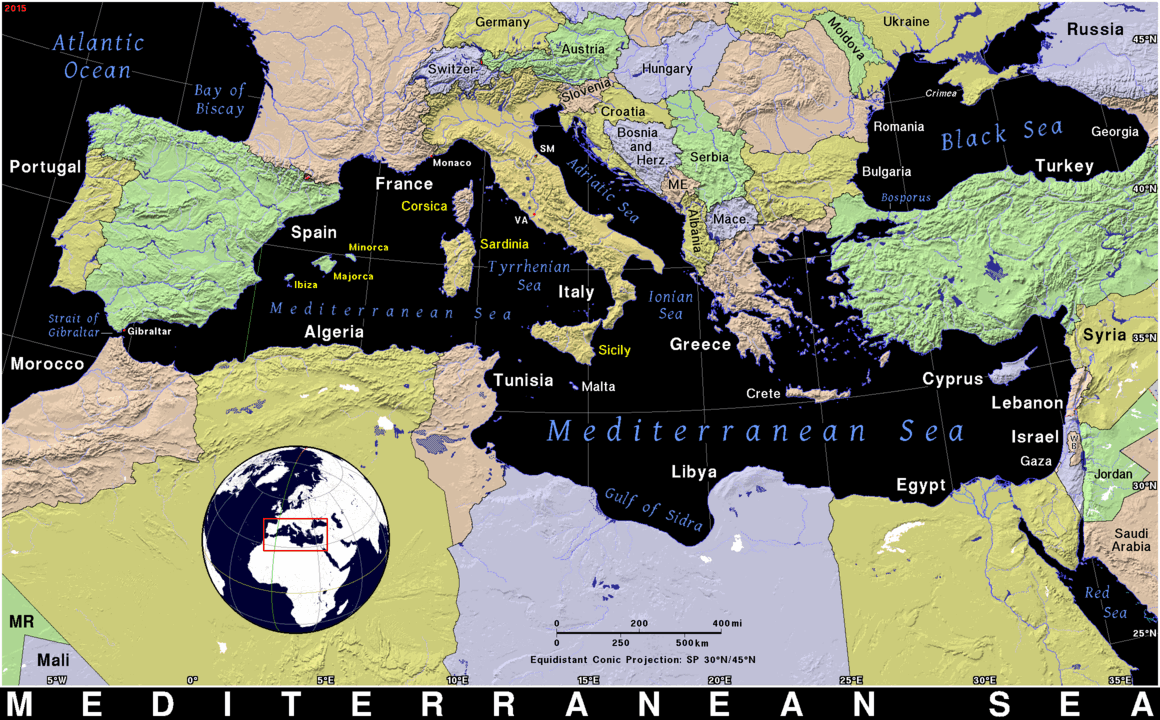
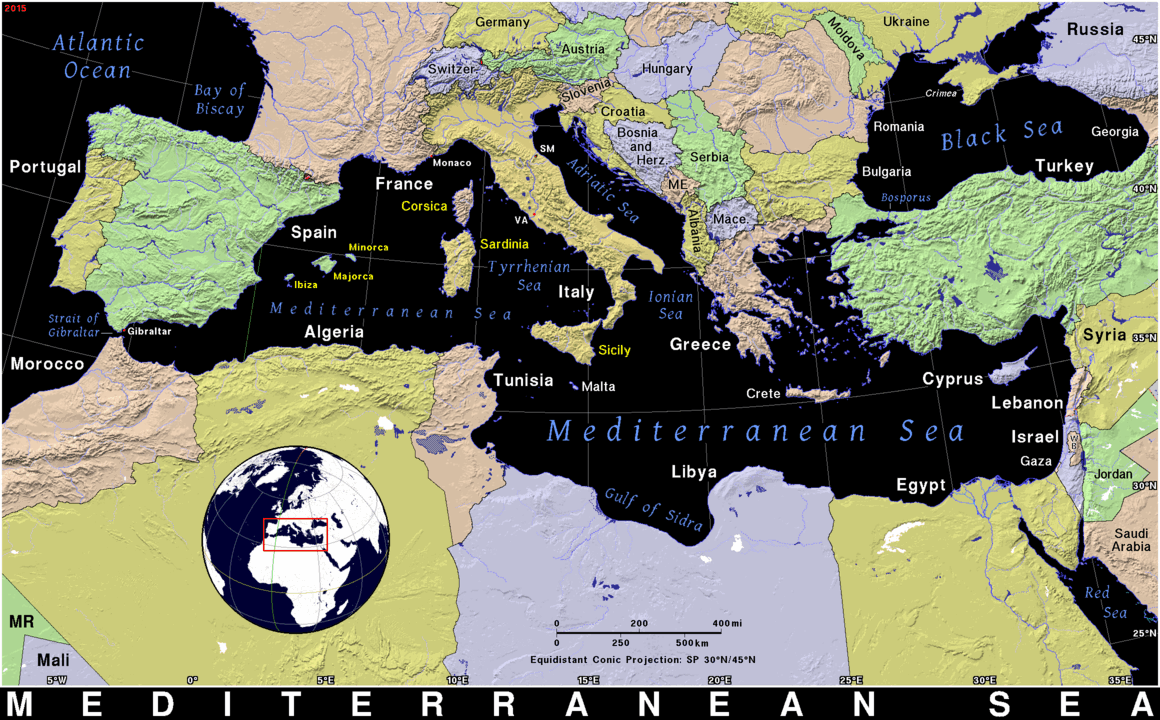
We’ve crossed the threshold into Winter, here in the northern hemisphere. And when orienting towards a tree-scape for this next post in this tritype series, all my inner paths seemed to lead south and east – to the Mediterranean region1 and to its ancient olive groves.
As we December (verb) and approach the darkest days, the winter solstice itself, and the cluster of festivals celebrating light in darkness, the symbol of the olive branch, held in the beak of a dove, appears on Christmas and cards, as it does each year.
In this time of global political turmoil, it feels important to do some of this wintering journey here, in the deep place of self-compassion and renewal offered by the Olive tree, and in exploring some powerful human correspondences with this tree and its fruit. A little potted olive tree in my garden, and a candlestick made of olive wood are a way for me to feel connected to the spirit of Olive.
Orienting consistently towards the light, and remaining fruitful and constant in changing seasons, climates, and conditions, is the character of the Olive tree, and also the character of the 279 tri-part enneagram archetype. Points 2, 7 and 9 are the three most positive in each centre of the enneagram. And when they are healthy and mature, people living here are also deeply regenerative people - both in their own living, and in our human ecosystems.
An archetype that combines these three types, the 279 is highly predisposed to wanting to make the world a better place, to improving the lives of others, and to moving through difficulty, to seeking the light in any given moment. This does not mean however that a 279 human living with this pattern will be unfailingly sunny; indeed, these people often have hardship and strife to live through to move through in their life story.
Spending time with Catherine to explore this space and this tree connection was an immense gift. She is a 972 who travels from her home in South Africa to the Islands of Greece whenever she can. She shared how strongly she feels a profound sense of belonging there, held by the landscape, and especially, by the olive trees.

This piece is part of a series exploring correspondences between trees and humans, using a three part enneagram typology as a kind of imaginal bridge between human inner landscapes and treescapes. It is rooted in a belief that the trees have much to offer us in their ways of being being as guides, allies and teachers. See this offering to explore your own tritype in treescape.
Olea as a genus appears in the fossil record 20-40 million years ago. It includes all Olives and their close relatives. These trees thrive in the Mediterranean, (and also in Africa, Asia and Oceana) because they tolerate heat and drought, rocky soils, and intense sunlight. They regenerate and resprout from old roots and trunks, and their dense hard wood resists decay and pests. Wild olives can survive fires that kill most other trees; an Olive tree can live for thousands of years.
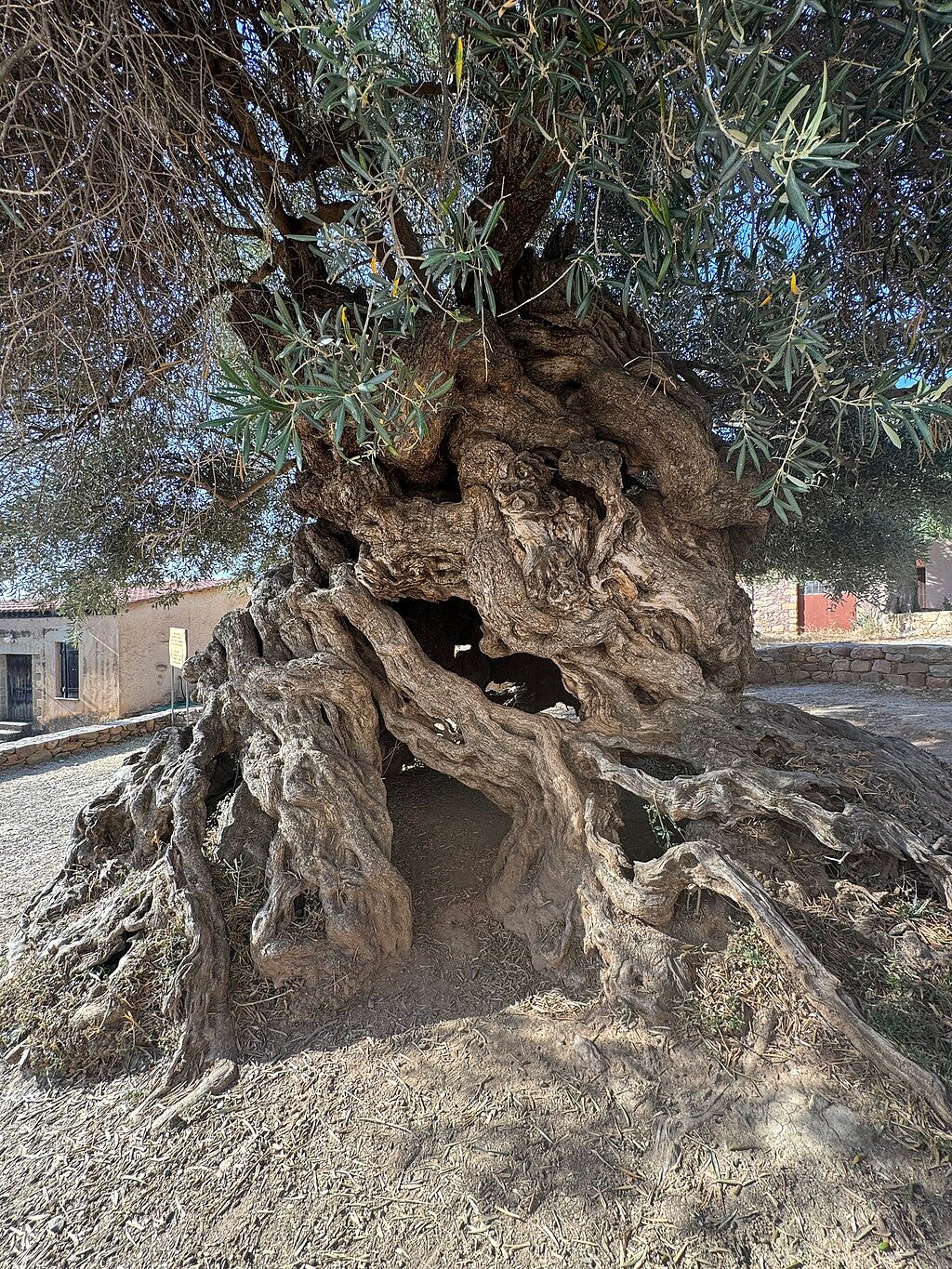
Humans first began cultivating wild olive trees around 7000 years ago, in regions such as Syria, Palestine and Crete. For millennia this tree has become a symbol of peace across cultures and religions. There is strong evidence that Olive was revered as a tree representing aspects of the Great Mother as well as being significant in the religions when God became worshipped as male. For example, Olive was prominent in pre-Greek Hittite religion, where female deities presided over agricultural cycles. Oils extracted from trees were used in libations, anointing, and consecration ceremonies, rituals that, for those who know a tree as a spiritual being , deepen that relationship and invite its influence.
The Olive branch remains a symbol we extended when we want to build bridges, and to repair ruptures, in a spirit of love and understanding. Olive carries an ancient transmission of spaciousness – an energy that upholds, calms and inspires higher possibilities. It brings new life.
I learnt from Catherine how important the spaciousness of the sky and the sea are in her connection with the landscape. I contrasted the closeness and intimacy seeking of the 269, another positive and encouraging archetype which I paired with moss in an earlier post in this series. Bringing the 7 energy into the mix changes the whole dynamic: it introduces a form of caring that amplifies the nine in offering freedom. Catherine emanates this kind of unconditionality. And so does the Olive tree.
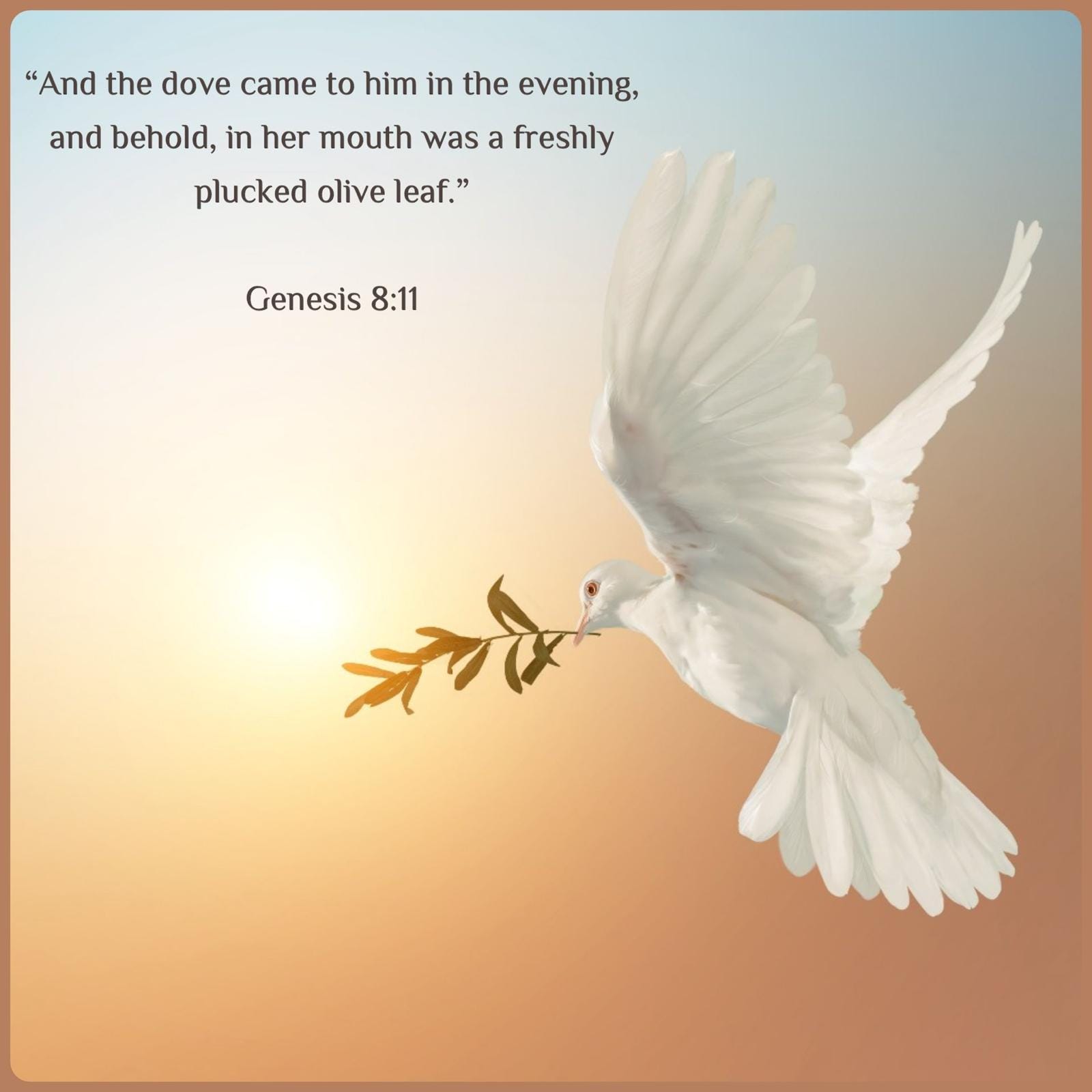
In Genesis 8:11, a text shared across the Jewish Torah and the Christian Bible, a dove carries an olive branch as a sign of hope – proof that the land has re-emerged after a great flood. The Olive branch indicated that not only is there land, but that it is fertile land that can be farmed. It symbolised regeneration.
The Olive tree also takes on deep spiritual significance in the Qur’an, and my friend Ahmad Yousri (read him on here) helped me to understand this. Olive Oil is used to burn lamps that give light, which is a central metaphor in Islam for spiritual illumination. Noah appears as the prophet Nuh in the Qur’an, and his story ends with the destruction of corruption and a fresh beginning for humanity.
Here is Olive in a section of the Qur’an : 24:35 — known as Ayat an-Nūr (The Light Verse)
“Allah is the Light of the heavens and the earth.
The similitude of His light is as a niche wherein is a lamp.
The lamp is in a glass. The glass is as it were a shining star.
This lamp is kindled from a blessed tree, an olive neither of the East nor of the West, whose oil would almost glow forth (of itself) though no fire touched it.
Light upon light!
Allah guideth unto His light whom He will.
And Allah speaketh to mankind in allegories, for Allah is Knower of all things.”2

I find great hope in this passage, and particularly the section ‘the lamp is kindled from a blessed tree, an olive neither of the East nor of the west’. I am not alone in reading this as signifying that God is beyond regions, and that the illumination of spiritual light transcends culture and geography, and any one religion. It also points towards reconciling dualities of spirit (east) and matter (west). And a mystical interpretation might even emphasise that true divine light is beyond our comprehension at all, and simply eternal.
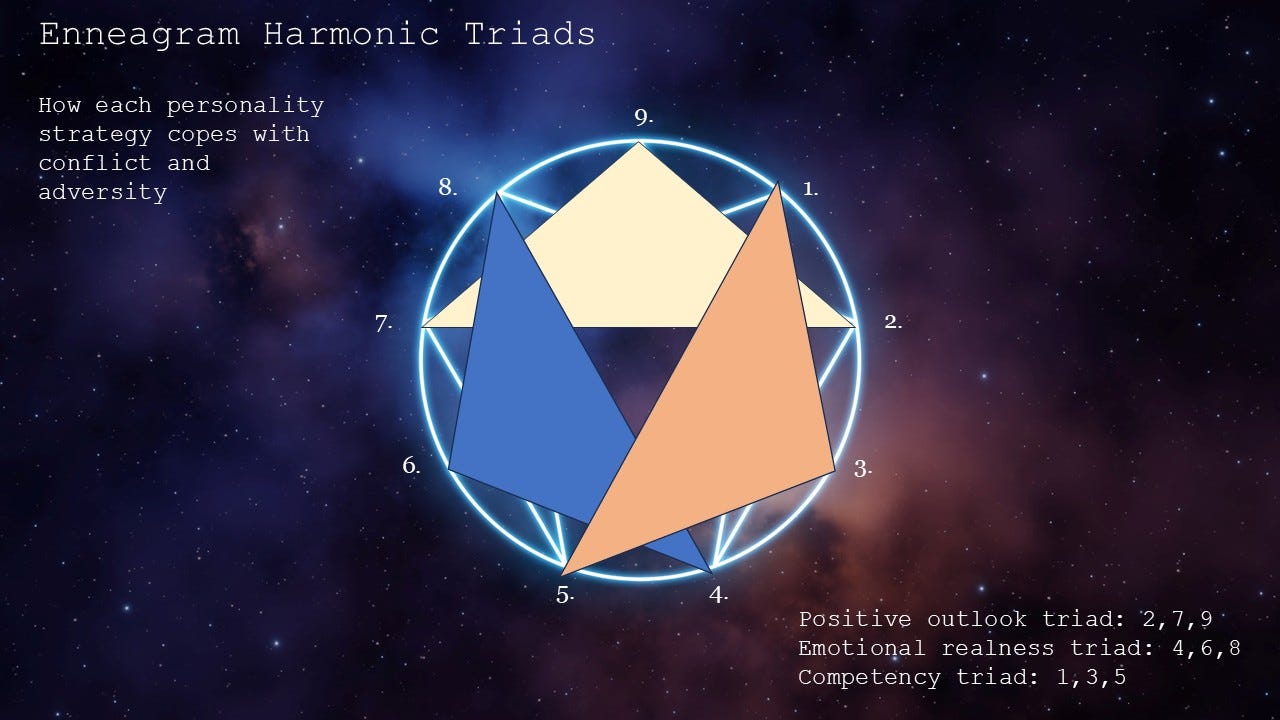
Coming back down to the human dimension, where we wrestle with all kinds of energies and impulses, the Enneagram harmonic groups help show how each point on the symbol copes with conflict and difficulties, obstacles and disappointments. Each triadic group contains a point in each centre (see image above) . Types 2,7 and 9 are all in the same group, so the 279 archetype is triple positive. Each part of the pattern focuses on a different way of remaining positive. Twos focus on the needs of others, and on being generative. At their best they are true humanitarians, and very kind. Sevens focus on positive framing of events and experiences and can quickly move on to the next thing after failure. They are the pioneers, and have a genuine capacity for celebration of life force. And nines are focused on harmonising their environment, and on minimising friction for others. At their best they are truly inclusive leaders, and with their own best interests included.
Each of these ways of being also brings a struggle of deeper becoming: a ring of fire that must be walked through. The two personality can get caught up in relational thinking, and see self as entirely loving and focused on the other. Humility comes only when the pride in being loving is released, and self-care and self-love is discovered. Paradoxically Seven is a great seeker of freedom, but is also an impulsive pleasure seeker, and a great escape artist from arriving in the present moment. Sobriety comes when they stop and land into what they have been running from; ordinary life and discover in it their human capacity for presence. And nine seeks to include and harmonise the whole universe by minimising conflict, but in so doing forgets self, and can drift in and out of consensual time, buffering self from the pain of knowing all suffering as their own.
You can see the seeds of the redemptive spiritual qualities in these archetypal journeys? Through the other side of these initiations the 279 becomes the hard won wisdom of a true peacemaker, and in their domain is a spirit of redemptive love and healing of suffering. Catherine spoke of these and of a big piece of work that she had had to do in the wake of the ending of an important relationship. Her time on the island of Ithaca was a kind of healing journey where she faced some of these deep soul challenges. It is my belief that when an individual human does their inner work, that it is a gift that serves consciousness as a whole.
There are ways each point can self-forget: two loses themselves in an imagined version of the resistant or negligent other, the seven can become scattered and feel a loss of being connected to ground, and a nine can become numb and lost in a kind of hazy fog of rumination. Self-remembering can happen when a human becomes present to themselves in each of their three centres: body mind and heart. In our time together, Catherine spoke of how powerful it felt to become conscious of her feet on the ground:
“The feet have been a huge thing for me today… putting them flat on the ground gives me a sense of connection, grounding, and presence. Without it, I feel resistance and disconnection.”
So how can the Olive be a soul companion to the 279?
Over millennia, in the groves in the Mediterranean, the Olive has seen much war over land and struggle and trauma. It is witness to all that has been most holy and most unholy in the holy land. If trees bear witness to all of it, then the Olives have seen more of it than most. They have the long view; a view that humans cannot hold. Just being in the present of an ancient tree like the Olive at gethsemane or the Olive can be awe-inspiring. Perspective giving.
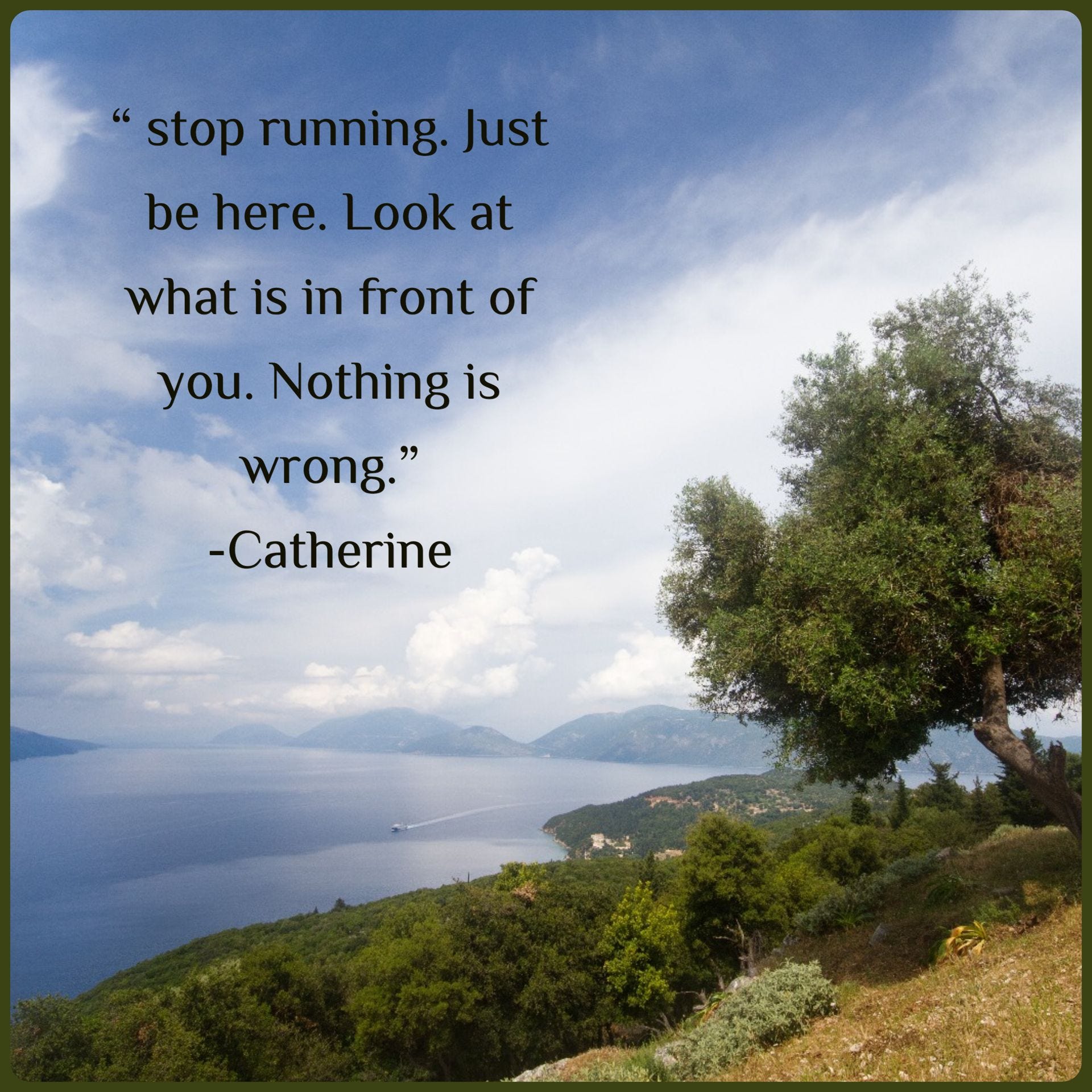
Catherine spoke of a moment on Ithaca with an old Olive tree where it became a kind of focus for her heart; a place of arrival. As she stood there, present to herself in a new way, the thoughts came
“Stop running. Just be here. Look at what is in front of you. Nothing is wrong”
My friend Rob Hutchinson also identifies at nine and is an Egyptologist (read him on here) and he takes a very long view of history. Nines often have a longer more open-ended sense of time; his is also embedded in ancient Egyptian philosophy and a non-linear comprehension of time encoded in what we can still perceive of Egyptian life. This is transmitted to us now, for those with eyes to see, through the symbology of its architecture and world-view, conveyed through its surviving texts. Olive trees appeared in Egypt circa 1500-1200 BCE. The Olive was not actually native to Egypt, but was introduced from the Levant under rulers with active connections to Syria.
Rob showed me the way that olive tree is written in hieroglyphics3. It has four symbols, the fourth being the generic tree symbol:

What is very interesting is that the first two symbols, the snakey one and the hand, are the same symbols that mean to speak:

So the olive is described as a tree that speaks. I wonder if its reputation preceded it, and that the Olive was an oracular tree already when it arrived in Egypt. If the christmas cards and scriptures and intuitive knowings are anything to go by, Olive is still speaking to us, of peace and renewal and generosity of spirit, across many lands and across many human divides.
With this message of peacekeeping in mind, I would love to close by sharing something of the holy ideas belonging to the 279 archetype. Almaas4 conceives of the universe as an organism, and each of these ideas as a Facet of Unity: unconditioned, objective and experiential understandings of reality. For ordinary humans, they are ideas to be wrestled with on our human journey. We are lucky to experience glimpses of these glimpses of a consciousness from another dimension.
At two there is holy will, an understanding of a unified unfolding of the universe, as a kind of doing. The Self, aligned with holy will, feels safe in the experience of ‘what is happening’, no longer in conflict with the will of the universe. Holy freedom is also found here. These are gifts of humility, the virtue of two.
Holy wisdom is found at point seven. This is a gift of sobriety, and of being present and in a state of trust that you are part of an unfolding design; a holy plan. Not something to strive after, but particpate in.
And at nine there is holy love. Nine sits at the top of the enneagram and crowns it. (This is why self-remembering is a task for all humans, not just the nine). Holy Love is a quality of existence that makes existence itself lovable; enjoyable; full of goodness. Not just a feeling, but ‘the intrinsic quality of the reality of being that is nonconceptual positivity’.[3]
If there is an archetype that points towards peaceful life on earth, and towards an expression of these holy ideas, it is 279. And perhaps the Olive trees, holding their places in the sacred olive groves in the east, are, in the meantime, playing their part in holding the place for peace and goodwill to all humankind.
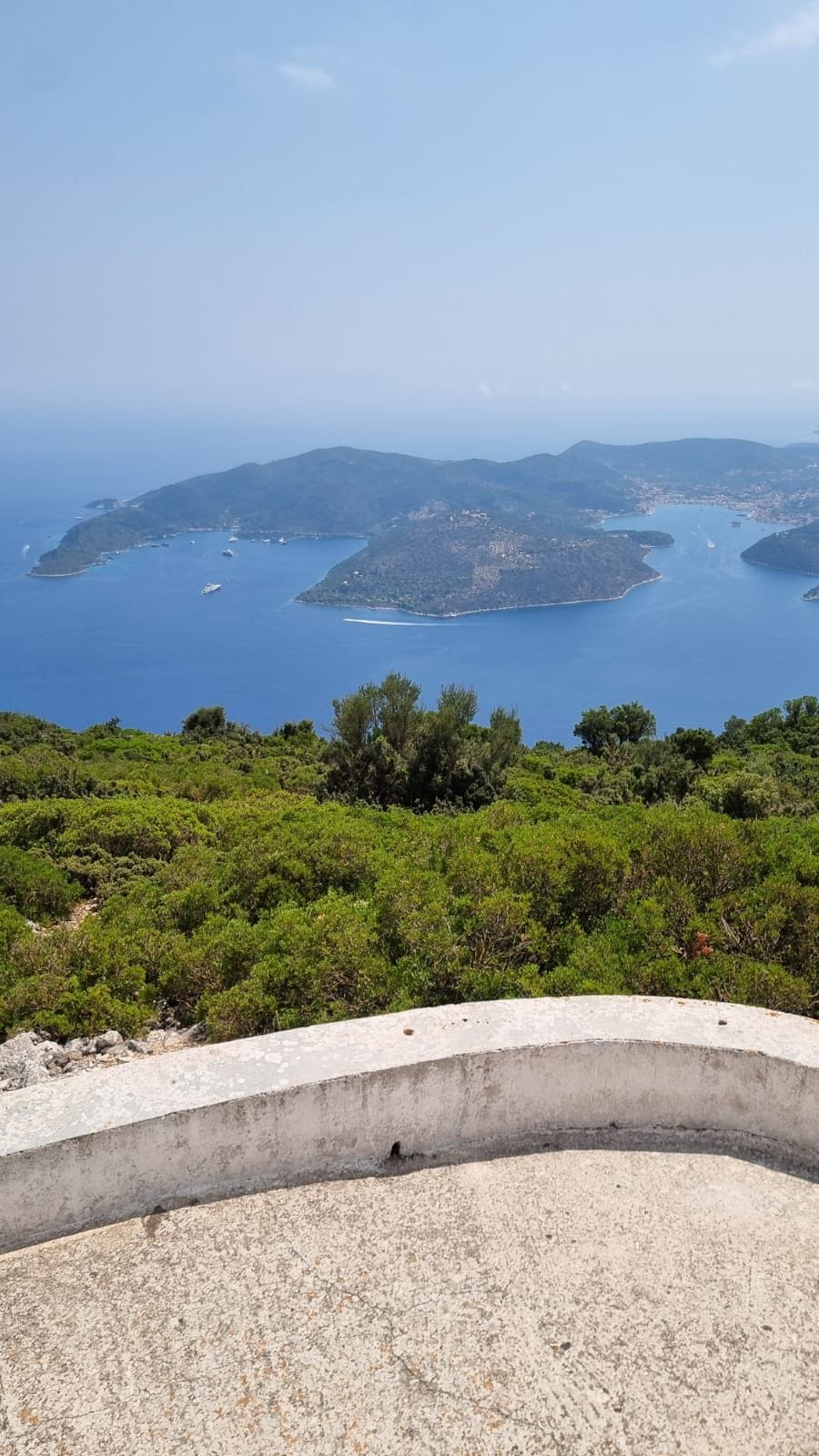
The Olive tree chose connected me and Catherine, as a part of this project, and she was able to convey something of the power of the Ithacan treescape in her own journey of becoming as a self-remembering 972. This last image is a view from the monastery of Kathara, on the sacred Mount Nirito, the highest point on Ithaca, and the spiritual protector of the island. This is a view of where her family scattered her beloved parents ashes.
Here is the greek poet Constantine P. Caveny to close, and his poignant poem Ithaka about human journeying. It came as a beautiful final synchronicty to learn while writing this piece that this poem also has deep personal significance to Catherine too, and that her brother read these words at her Father’s funeral. I am very grateful to Catherine for her generosity sharing part of her own journey with me for this chapter we shared with the Olive trees.
Ithaka by Constantine P. Cavafy
As you set out for Ithaka
hope your road is a long one,
full of adventure, full of discovery.
Laistrygonians, Cyclops,
angry Poseidon—don’t be afraid of them:
you’ll never find things like that on your way
as long as you keep your thoughts raised high,
as long as a rare excitement
stirs your spirit and your body.
Laistrygonians, Cyclops,
wild Poseidon—you won’t encounter them
unless you bring them along inside your soul,
unless your soul sets them up in front of you.Hope your road is a long one.
May there be many summer mornings when,
with what pleasure, what joy,
you enter harbors you’re seeing for the first time;
may you stop at Phoenician trading stations
to buy fine things,
mother of pearl and coral, amber and ebony,
sensual perfume of every kind—
as many sensual perfumes as you can;
and may you visit many Egyptian cities
to learn and go on learning from their scholars.Keep Ithaka always in your mind.
Arriving there is what you’re destined for.
But don’t hurry the journey at all.
Better if it lasts for years,
so you’re old by the time you reach the island,
wealthy with all you’ve gained on the way,
not expecting Ithaka to make you rich.Ithaka gave you the marvelous journey.
Without her you wouldn’t have set out.
She has nothing left to give you now.And if you find her poor, Ithaka won’t have fooled you.
Wise as you will have become, so full of experience,
you’ll have understood by then what these Ithakas mean.
🌀🌀🌀Unfurlings is my paid subscriber space on Subtack — a gentle community layer of this work that sustains and nourishes it. We do not do this inner journeying alone. Subscribers are also warmly invited to a free monthly live gathering, a gentle space to reflect and unfurl together. You’re very welcome if you feel the pull.🌀🌀🌀
Meditterenean map: https://ian.macky.net/pat/map/medi/mediblk2.gif
Qur’an : 24:35 — known as Ayat an-Nūr (The Light Verse)
Budge. E.A. Wallis. An Egyptian Hieroglyphic Dictionary Vol 2. Book Jungle. 2007
Almaas. Facets of Unity. Shambhala. 2000
Wow! This was a remarkable read and what an ending. I had never read this poem Ithaka. I will need to read it several times. It is very moving and I could hear so much in it that speaks to and supports the 7 and 9 in me. Thank you!