

Anna welcomed me
to her orchard garden.
A little Italy in a Hampshire village.
Anna had lent me her white sun hat,
and a garden chair,
and gave me a bottle of water.
I regarded her red fig tree from a little distance.I needed that sun hat and that water.
The sun was high and strong.
It meant business.But so did the fig tree.
After a little while,
the self conscious Brit in this warm ficheto,
felt the week behind me begin to ease off.I breathed there for a longer while,
for a good long whiling while,and then I felt its invitation.
I made my way underneath her limbs.
Into her cooling place,
with her big green sheltering hands.Five lobed. Like mine.
Fig was waiting for my deep sigh.
To her sanctuary, fig invited me.
In my deep sigh,
she met me.
Tree: Fig
Moon: Mead moon, strawberry moon - height of the light.
Archetype: Enneagram 925– The harmoniser.1
Virtues: Right Action (9), Humility (2) Non-attachment (5)
Holy ideas: holy love (9) holy freedom (2) holy faith (5)
Some rings of fire: self-remembering, receiving, revealing self.
To spend time with a tree, and to get to know its shapes, and habits; to grow accustomed to the feeling of being in its presence; to see the other wildlife that likes to be up close to it; its birds and insects, its visiting animals and its understory; is to enter into its way of being alive in the world.
Since we humans also have adopted different ways of being alive in the world, there is a kind of mirror we can look into, by being with a tree. Since the enneagram symbol is another powerful way of learning about how energy moves through any given architecture or vessel, I have taken to exploring the three centred enneagram types2 along with the trees I have found that map them the most closely.
This is the eighteenth post in this series of twenty-seven tree-scapes.
Access the complete set here:
It has been a long meandering journey. I have been walking with fig trees since May, and in the whole lead up to the summer solstice and the height of the light. The intense heat here has been a companion to my research for this piece.
Along with my trip to Anna’s garden, I visited fig trees in London with Rob, met with the 400 year old fig tree in Lambeth palace, and zoomed with tree-loving friends, Tracey and Talia, in California and Mexico, both places where Fig has been cultivated for several centuries. Rob and Tracey know this archetypal enneagram pattern from the inside, and Talia, another enneagram friend, has loved Fig trees since childhood. Jelena, the collage artist who helped me to illustrate this piece is also a serious enneagram student. It has been deep and rich habitat to explore together. I very much hope they will add to this collaborative piece with any further reflections.
To fully explore the significance of the fig to human societies, we must travel much further back in time to figs ancestral home, to the land of the eastern Mediterranean Basin; Turkey, Cyprus and Greece, through the levant; Jordan, Syria, Cyprus, the current Israel, and the palestinian territories; and, further west still, into the near East; to Iraq, Iran, and Afghanistan and Pakistan.

It was there, over 11,000 years ago, that figs became one of the first fruit trees to be domesticated, as evidenced by archaeological discoveries dating to prehistoric times. From the Near East, fig cultivation spread into the Mediterranean and soon reached southern Europe, where the tree became deeply embedded in local cultures and landscapes.3
The regions of fig, like the regions of olive, have known war and the excesses of human destruction. It is important to recognise that trees are doing their work to regulate and resource humans in extreme conditions. In her 2003 sestina, Morning news, Marilyn Hacker shows us a war-torn human landscape which includes a fig tree:
Spring wafts up the smell of bus exhaust, of bread
and fried potatoes, tips green on the branches,
repeats old news: arrogance, ignorance, war.
A cinder-block wall shared by two houses
is new rubble. On one side was a kitchen
sink and a cupboard, on the other was
a bed, a bookshelf, three framed photographs.
Glass is shattered across the photographs;
two half-circles of hardened pocket bread
sit on the cupboard. There provisionally was
shelter, a plastic truck under the branches
of a fig tree. A knife flashed in the kitchen,
merely dicing garlic. Engines of war
move inexorably toward certain houses
while citizens sit safe in other houses
reading the newspaper, whose photographs
make sanitized excuses for the war.4
Fig invites us to gather into our shared humanity, and into our deep knowledge. I would like to share something of Fig’s way of being here, and to offer its mirroring correspondences with the enneagram points of nine, two and five.
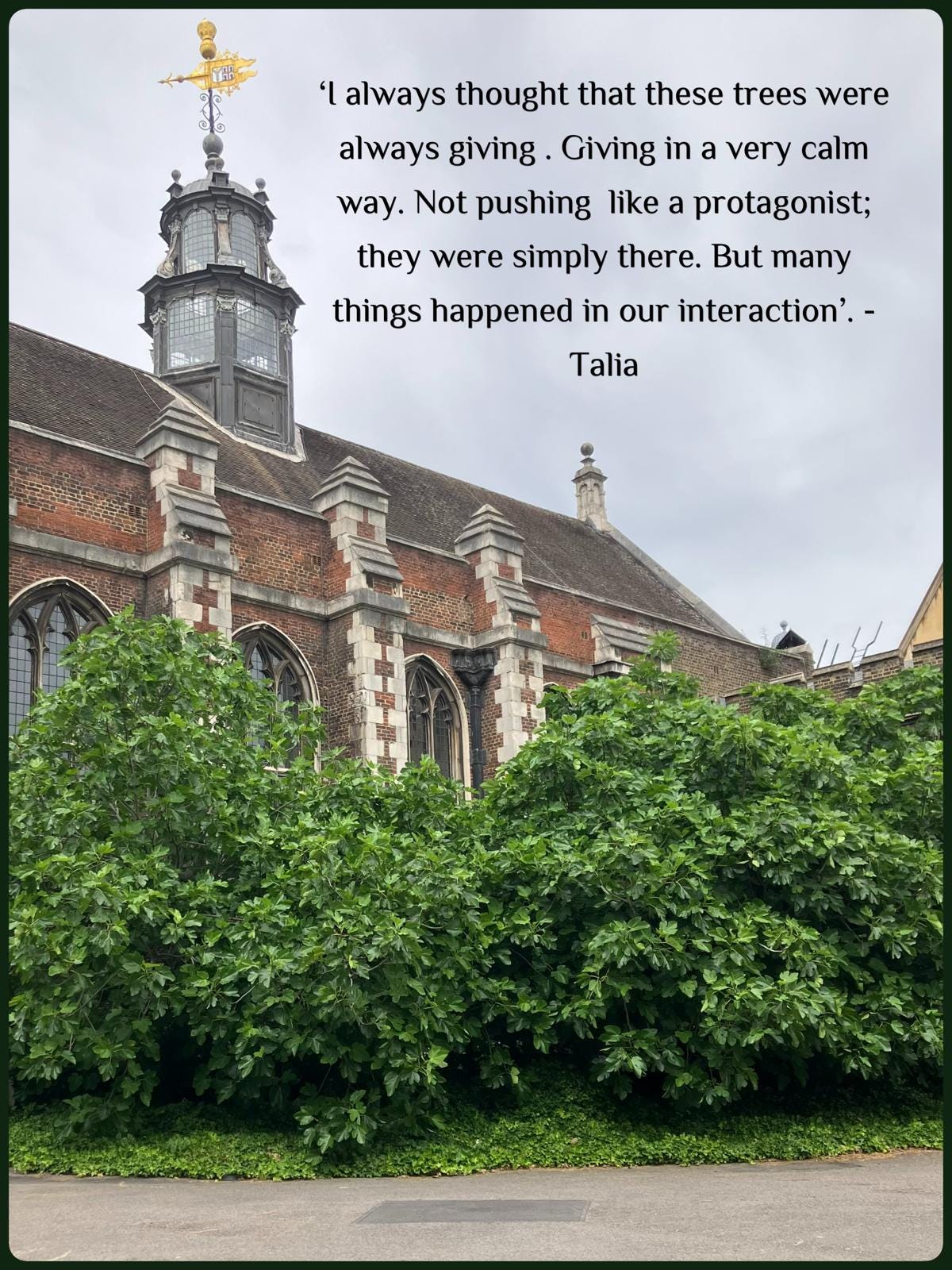
The wide-reaching limbs of a mature edible fig tree create a framework that the large five-lobed leaves cover, to create a sanctuary space within. In the case of the Lambeth palace fig tree, which has been growing for four hundred and seventy years, it can be hard to believe there is only one tree growing.
Children living in many countries around the world have known this kind of tree-house sanctuary. Talia told me about a tree in her Grandmother’s garden in Mexico that she loved as a child. The tree was a shared reference for the family; she would play in its branches peeping out at the world around her, and then from the kitchen she would be called by her Grandmother to get a basket to gather fruit from its boughs.
Enneagram point nine, viewed archetypally, sits atop the enneagram and creates the conditions for the whole of life and all the other points to remain connected. In the enneagram of personality, this means in our human ecosystems too. Nine represents the circle and the law of one, as well as being part of the inner triangle and the beginning and end-point of the law of three (369). And of course it is a point in its own right in the set of nine points. Nine is spacious and inclusive, and along with point two, is a positive outlook type.
“I can be incredibly present with people. Nines have a capacity for advanced presence”.- Rob. 952
However this presence to others is characterised by a kind of merging quality, and humans living here can be prone to self-forgetting.
Nine is in the body centre and is concerned with boundaries and agency. Imbalance at nine causes suppressed rage from self-forgetting to erupt. Healed nine remembers self and knows its own part in life unfolding.
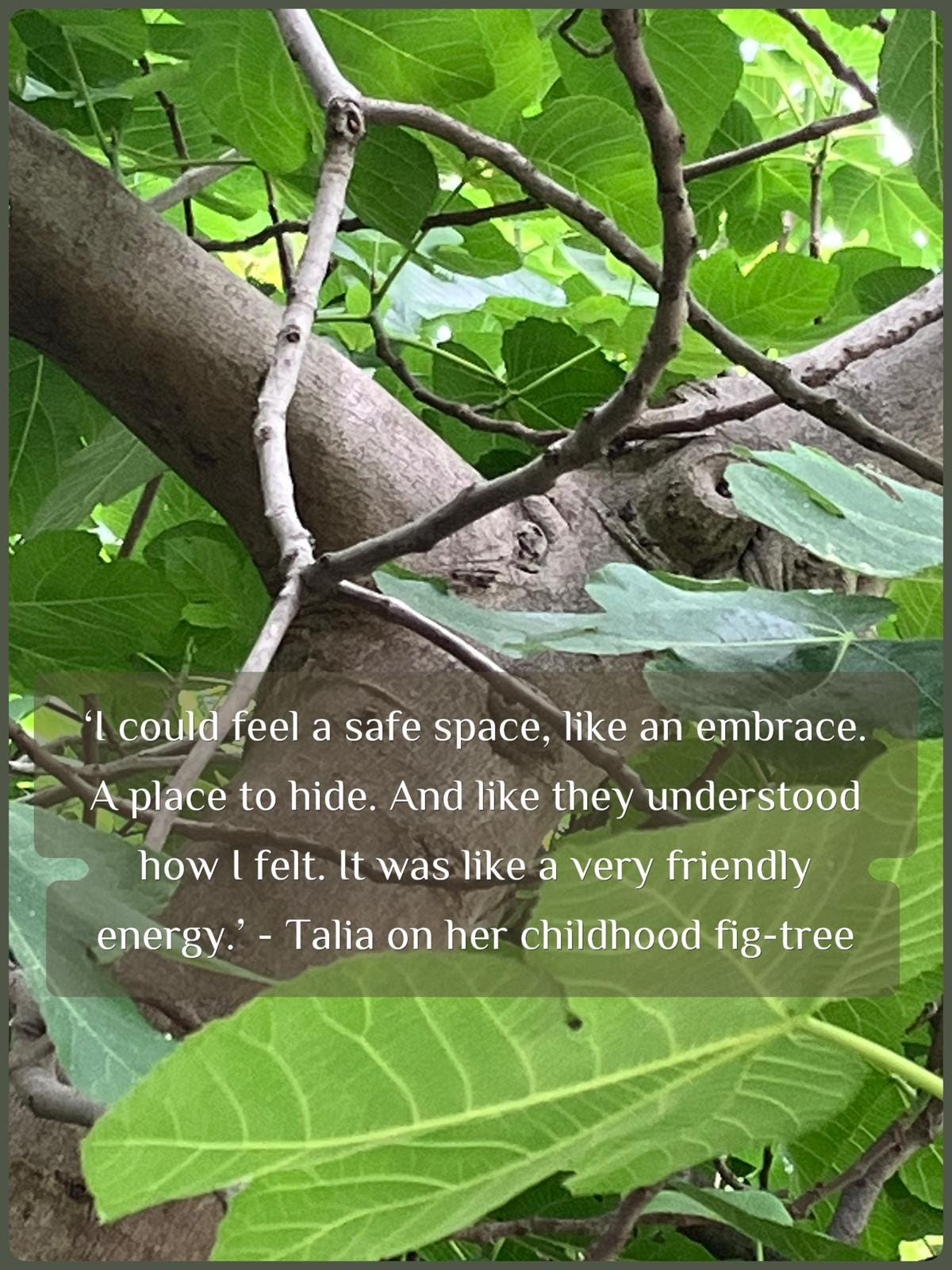
A fig tree unfolds outwards. From a sturdy trunk, the branches arc and twist, seeking light, unconcerned with symmetry. Each branch responds to the space around it, sun-seeking, and yet also energy conserving. Its large hand leaves tilt to face the light, and the protective shade they cast is plentiful beneath. This generous and expansive canopy intercepts the intense light of its surrounds, transforming its interior into a cool humid microclimate. This living architecture shelters the tree’s developing fruit, and conserves moisture around the trunk and root, making refuge for life beneath it. Birds pause, insects scurry and rodents forage here.
In many of its natural habitats, Fig is a keystone tree because figs are eaten by an extraordinary diversity of creatures: bats, birds, primates, rodents, reptiles and insects.
Enneagram point two seen archetypally represents relationship: The movement into knowing self and other, our movement into consciousness of our impact on others, and our attempts to make sense of that. The relational field is where relationship is where harmony and disharmony between us is experienced, where co-operation and conflict can happen.
Looking after their relational field is a core value for those who know two space. It is also where mirroring and reciprocity, call and response and dialogue can happen, and where differences and distinctions can emerge. Enneagram Two as a personality lives up close to both the joy of giving, and the pain of unmet emotional need.
Two is in the heart centre and is concerned with seeing and being seen and with holding and being held in heart space. Healed two knows true freedom in giving and receiving. Imbalance at two causes deep shame. Two can become fixated on being the most giving person and lose sight of the other other than a mirror for self. Healed two knows deep humility and love of self as well as other.
“Once I’m helping, there is no limit to the help. There is no self-preservation anymore,. Its just all about the help”. Tracey speaking about the challenges of living with the 529 pattern.
Fig leaves are highly specialised to adapt to the hot dry summers of the fertile crescent region and surrounding eastern Mediterranean zones they thrive in. Their leaves are large; most commonly with three to five deep lobes, and they can reach 25-30cm across, which creates a broad surface for capturing sunlight. Their rough, leathery texture and thick cuticle helps to prevent water-loss, since they must make the most of the rain when it comes. Between the lobes are indents known as sinuses, which carry away heat and help the tree to regulate its temperature. Each leaf is upheld on a long flexible petiole (its stalk) which enables it to pivot towards the morning and evening light with great efficiency, and to flutter in evening air, reducing overheating and wind-stress. Beneath the surface, a dense network of veins distributes water, minerals and sugars, while giving the leaf the strength to remain spread wide in full sun.
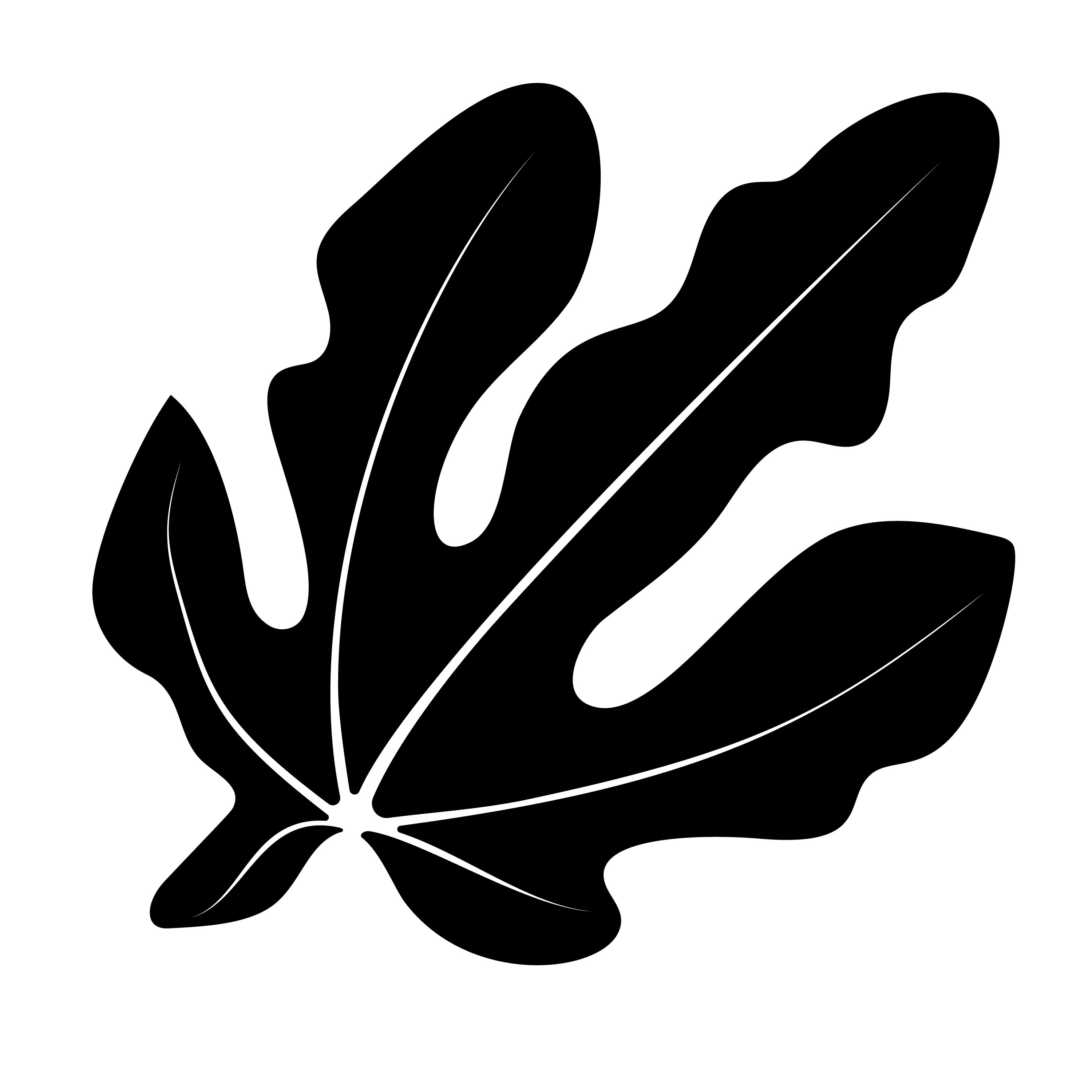
Enneagram point five seen archetypally, represents depth of learning. There is a completeness of this knowledge sought by the human identifying here. Symbolically the body of knowledge is held in the five fingers of each hand (where we first learnt to count) and there is a sense of wanting to scoop up and hold knowledge as an object; to internalise it, complete and whole. The five seeks expertise and veracity. Receives and imparts knowledge. Self is experienced as knowledge keeper. Five is perhaps the most self-contained and least social point on the enneagram. A five human references knowledge as a source of self-regulation, rather than its relation to other people. There is often a concern with energy loss as if any unpermitted interruption or request of their time is an invasion of the smooth running of this inner library. On the other side of their ring of fire, head centred five has moved beyond this dissociated kind of objectivity, and sought to make connection with self and other. Healed five becomes unattached to knowledge as object and knows themself as transparent and moving in their life as part of knowledge revealing itself. Other people can be included in this movement, as the five connects more with their heart centre.
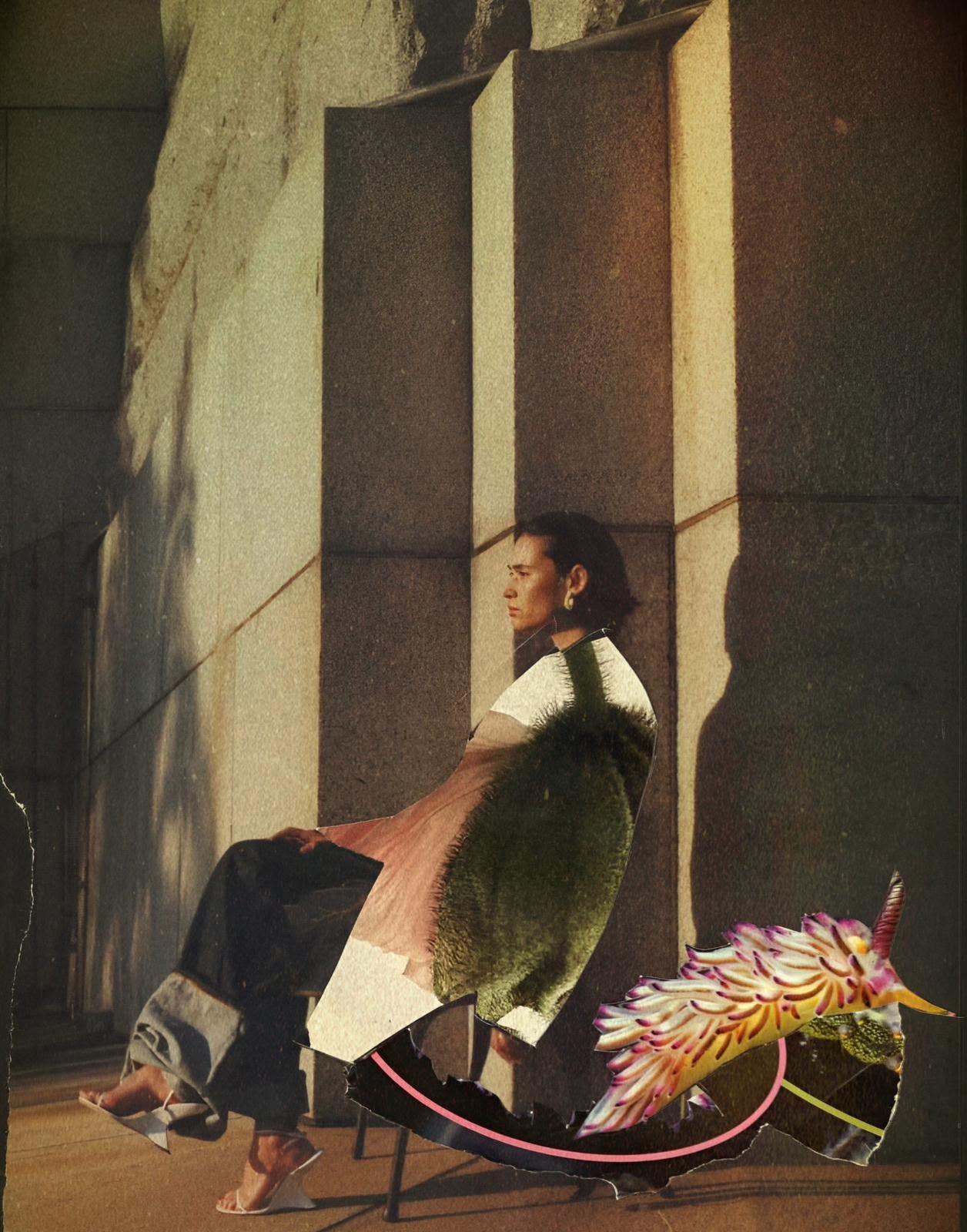
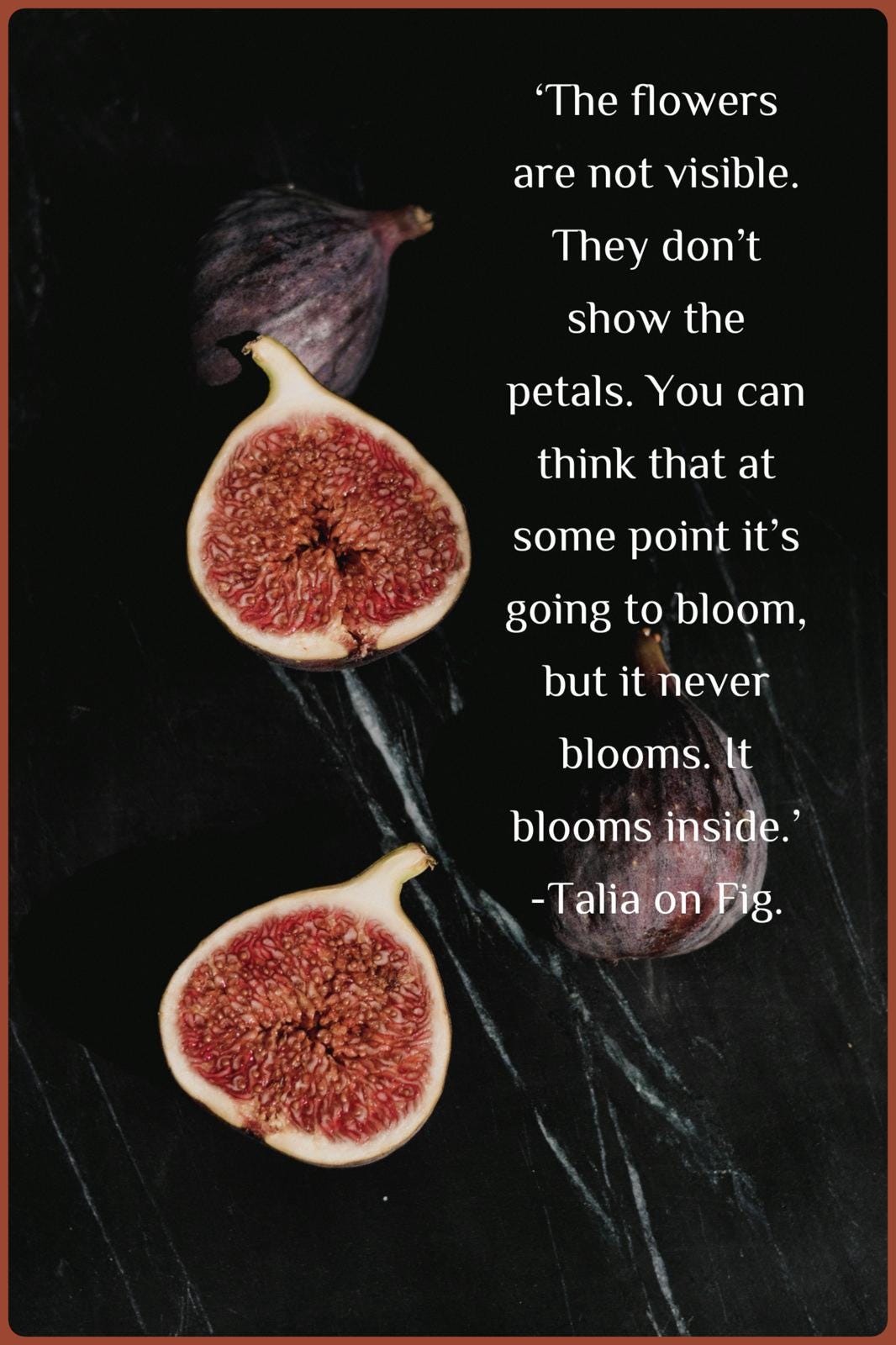
The fig trees fruit is one of the most extraordinary achievements of the plant kingdom, because it is not a fruit in the ordinary sense, because its flower is its fruit! A fig is known as a syconium, which is a hollow fleshy vessel lined on its inner surface with hundreds of tiny flowers. Rather than opening its blossoms to the outside world, the fig encloses them within this protective chamber, leaving a tiny pore at the tip, the ostiole, through which its special pollinators (fig-wasps - a different one for each species) may enter. Once pollinated, each tiny flower becomes a seed that becomes part of the ripe fig fruit we eat.
This inward-blooming design is remarkably efficient. The developing flowers are sheltered from the intense sun outside, the drying winds, and from other insects who cannot enter. while the fig grows ready to be ultimately eaten by the birds, mammals and people that will disperse its seeds. Each fig is like a tiny enclosed garden.
The 925 pattern can translate into an exceptionally resourceful human in community too. It is as though the reserve of the five protects the excessive other-focus of the two. The charming two can help to bring the self-effacing nine further out into community. Rob described it like this:
‘Theres a two at the doorway saying “come in!”’
And then the nine can offer their spacious capacity to receive others into its gentle micro-climate and leave them calmer, more resourced.
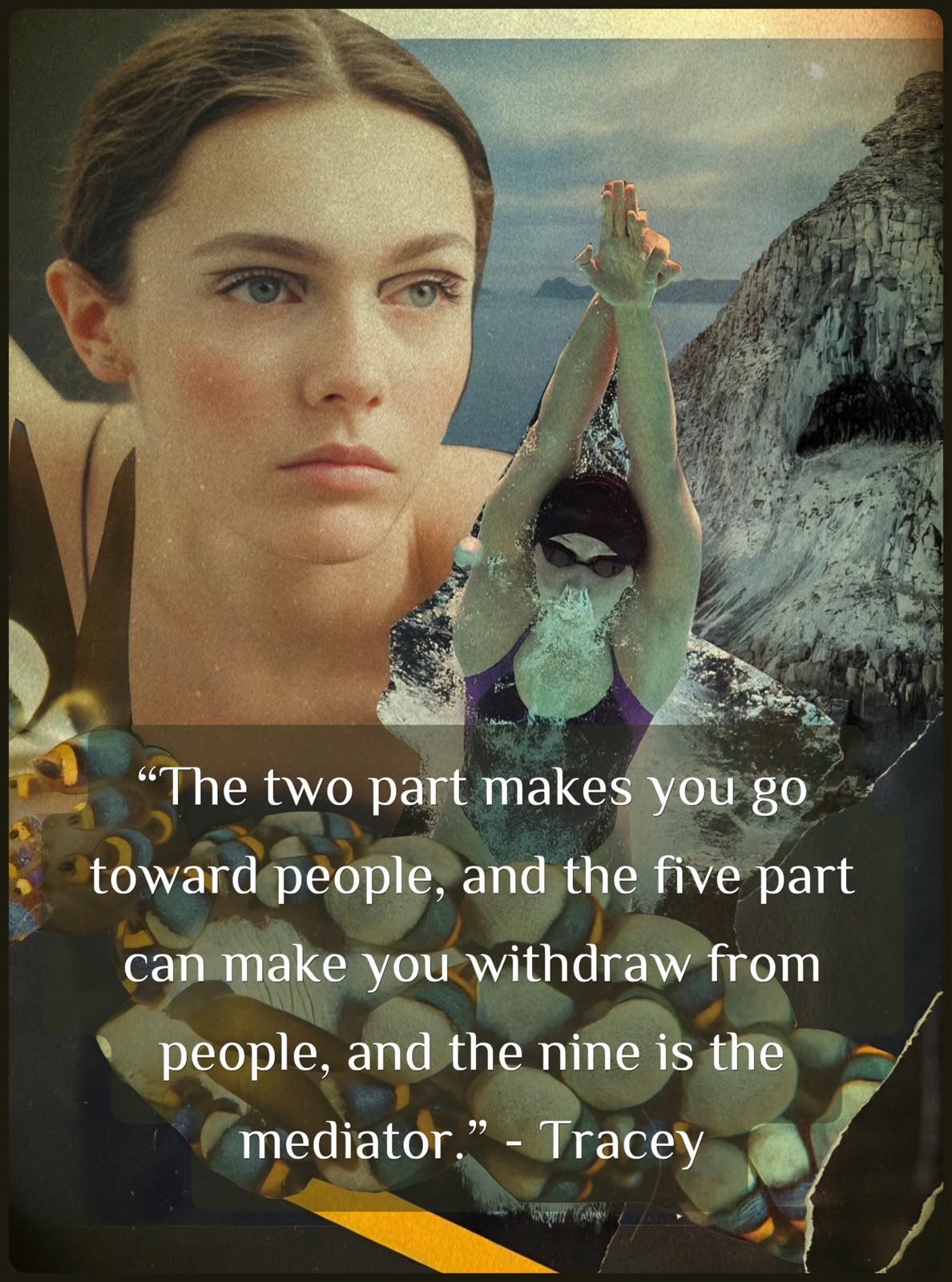
When these parts are working together harmoniously, there is a person that really wants to make an altruistic difference to the world, with research and objective thought included.
I spoke with Tracey and Rob about this. They shared some of the challenges. Since to hold these three dynamics in harmony is no small thing. The two is generous and helpful, while the five can be avaricious, and energy conserving; the two leads with their heart and seeks connection, while the five is prone to detachment and privacy-seeking. The nine wants harmony at all costs, while the five is unafraid of creating boundaries and can be a little prickly. The nine and five are very non-intrusive, while the two can happily insert themselves into other peoples business!
“The idea that I could be intruding on someone else’s sanctuary as a five, really horrifies me” - Tracey. On the challenges of living the 529 pattern.
This human will have had to wrestle more than most with the distress at the world not reflecting their principles of harmony, love and rationality.
“I don’t understand when another person isn’t a problem solver and looking to be a good Samaritan and help others find solutions” - Rob on the challenges of living with a 952 pattern
To embody their powerful harmonising presence in the world, the 925 will have had to really wrestle with these inner tensions and become really clear about self care. Self-remembering and love of self are growth points for 9 and 2, while the five at its best comes to know themselves as part of life unfolding rather than emotionally locked away.
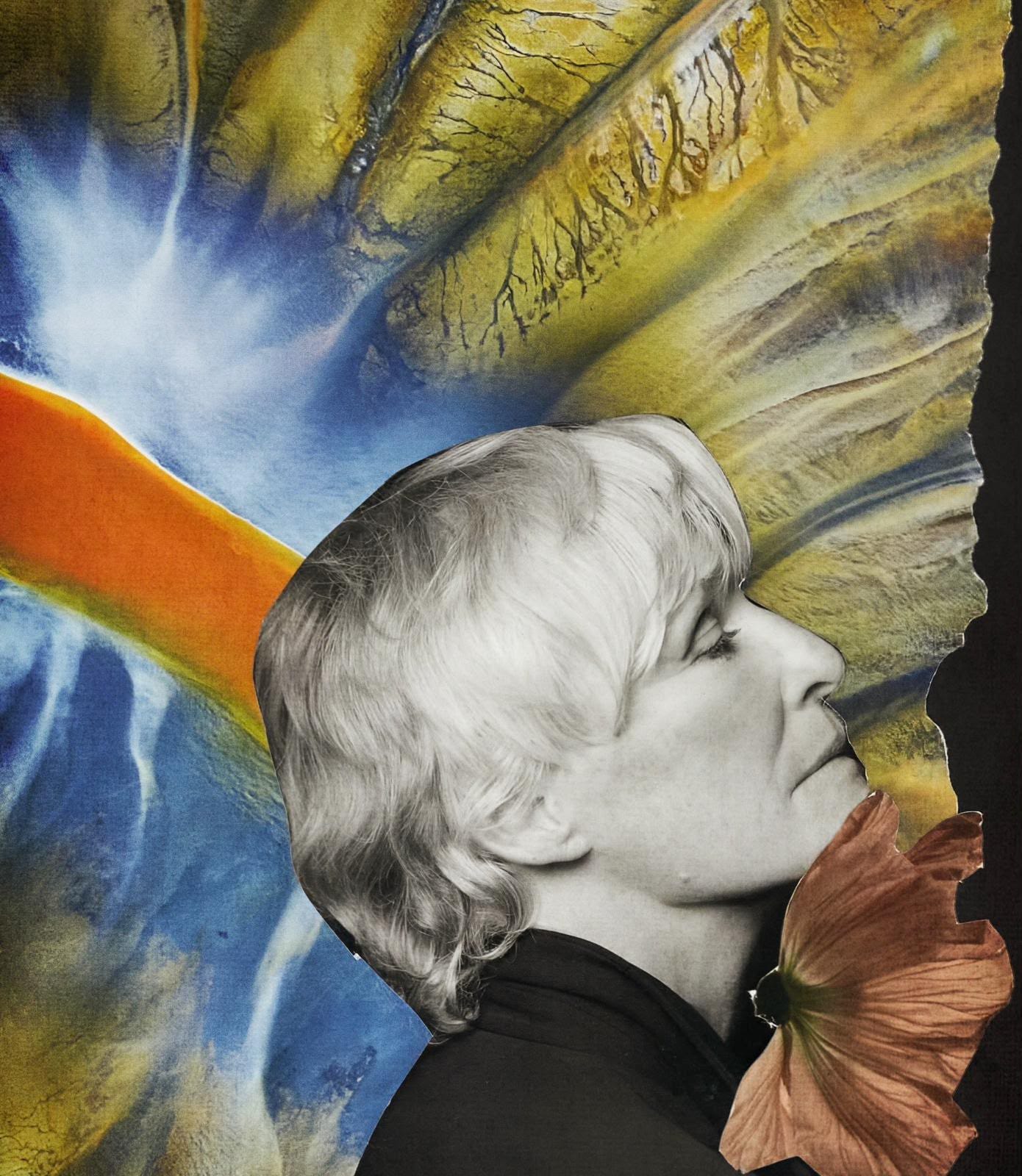
This all sounds superficially rather adaptive, as though the 925 learns to meet the world on its terms. This is not so. This is not a human that wears everything on their sleeve.
Rather, the world is given the opportunity to encounter the deep mystery of regenerative peace that this this tree, and this archetype, in its healed form, embodies and reveals. The mature 925 has learnt to embody a human expression of this harmonising archetypal energy, welcoming and receiving those who recognise their gifts.
When I came out from under the fig
Anna invited me in for coffee.
She told me more about the other trees in her garden
I told her about the harmonisers; the humans most like fig trees.
We were no longer strangers.Under Fig tree’s auspices,
How could we be?
Also named ‘The Problem solver’ by Katherine Fauvre.
Katherine Fauvre researched these three-centred enneagram patterns as tritypes®. This project is indebted to her work: https://www.katherinefauvre.com/
from the Kew garden website: https://www.kew.org/plants/fig
Planted in 1556, it is a White Marseilles fig tree and was brought to Lambeth Palace by the last Roman Catholic Archbishop of Canterbury: Cardinal Reginald Pole.
Illuminating, thank you.
After my morning Chi Kung in my garden, saying hello to all the beauties out there soaking up the sun, I soaked up this piece. Really beautiful and important insights about the 925 and the amazing Fig tree. Thank you Talia, Tracey, Rob and Sam!